
.svg)
.jpeg)
“I’ve Already Made My Dream Come True: I’m Going to Play Soccer in America”
Read more
.svg)

Are you an (international) field hockey player dreaming of playing in the USA? American Universities offer great chances to study and play at the same time with field hockey scholarships. We help you understand how to get one.

Trying to understand field hockey scholarships in the USA can be confusing. How much money can a coach offer? Is a full scholarship realistic? What is the difference between NCAA Division I, II and III? And can international players receive the same scholarships as American players?
The answers have also changed in recent years. New NCAA Division I rules introduced in 2025 changed the scholarship model significantly.
In this guide, we explain how field hockey scholarships work today, what different NCAA divisions can offer and what really matters when a coach decides how much scholarship money to invest in a recruit.
If you are completely new to the American college system, start with our guide to playing college field hockey in the USA.
A field hockey scholarship is financial aid provided by a university partly or entirely because of your value as a field hockey player.
The scholarship can reduce the amount you and your family need to pay toward your university education. Depending on the university and the financial package, costs can include:
However, receiving a field hockey scholarship does not automatically mean that everything is paid for. Some players receive substantial scholarships. Others receive smaller athletic awards combined with academic scholarships or other financial aid.
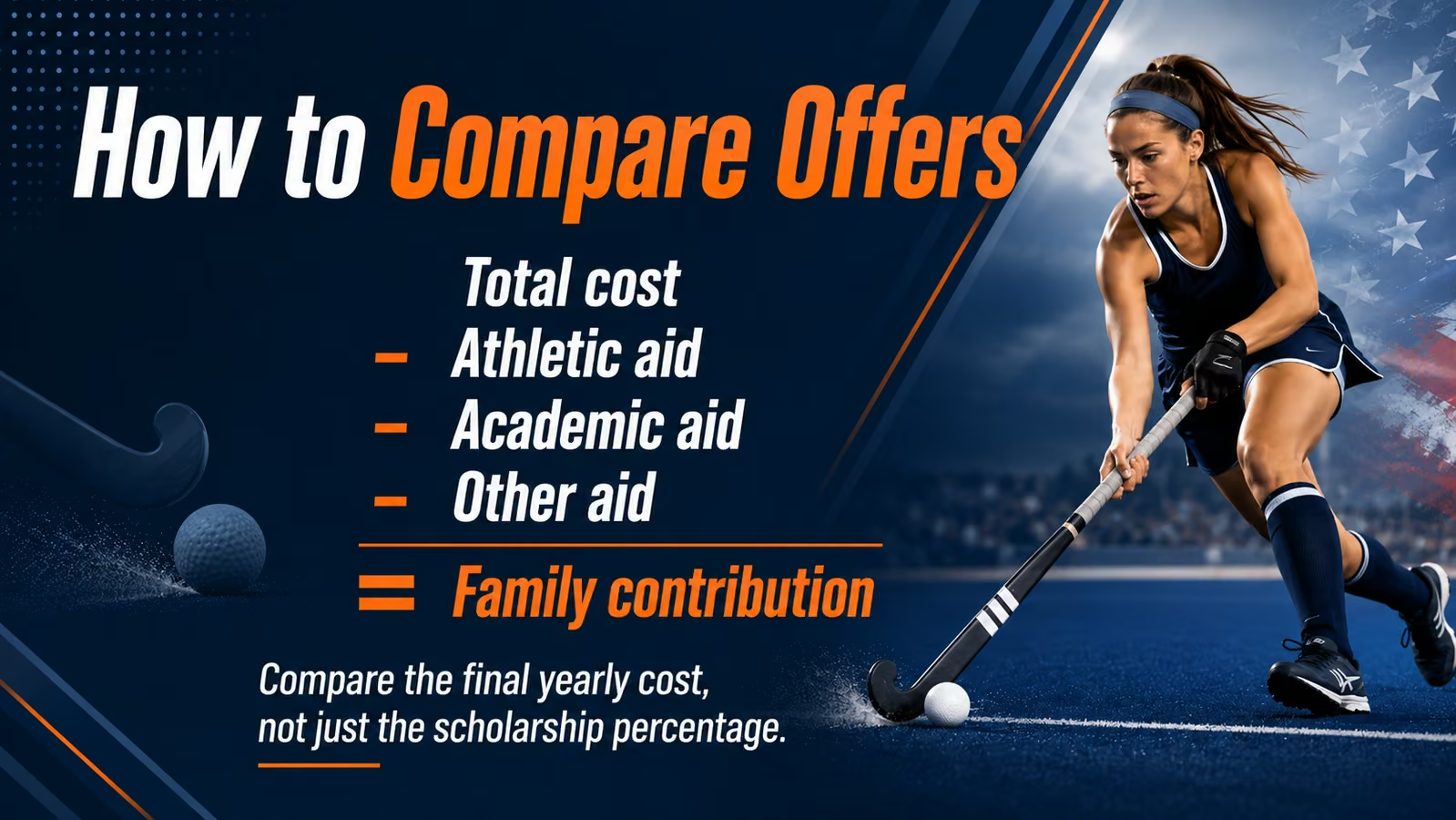
That is why the most important number is usually not the percentage of your athletic scholarship, but the final amount your family will need to pay each year.
You can learn more about the full financial picture in our guide to university costs in the USA.
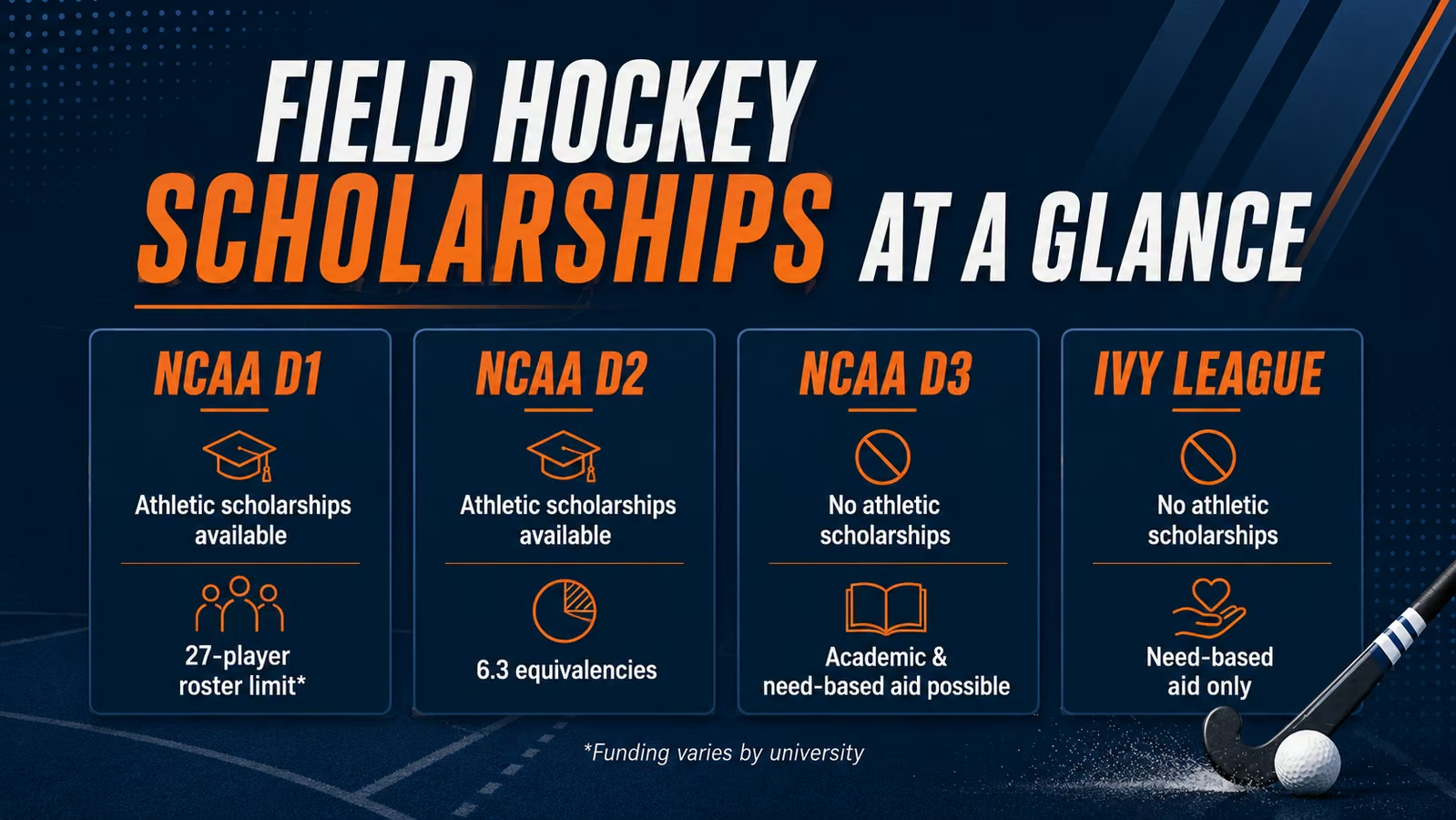
College field hockey is primarily played across NCAA Division I, Division II and Division III. The financial aid model is different at each level.
Division I is generally the highest level of college field hockey in the United States. The scholarship rules changed significantly in 2025.
Previously, NCAA Division I field hockey operated under a limit of 12 scholarship equivalencies per team. Under the new Division I model introduced following the House settlement, the old sport-specific scholarship cap has been removed for participating programs. Field hockey programs operating under these rules have a 27-player roster limit, and schools have greater flexibility to provide athletic scholarships to players on their declared roster.
Important: A 27-player roster limit does not mean that every Division I field hockey program offers 27 full scholarships.
The NCAA determines what schools are allowed to provide. Each university still decides how much money it actually allocates to field hockey. A well-funded program may therefore have considerably more scholarship resources available than another Division I program.
This is one of the reasons why two offers from universities at the same NCAA level can look completely different financially.
Division II continues to use an equivalency scholarship model. A fully funded Division II field hockey program may award up to 6.3 scholarship equivalencies across its team. Coaches can divide that amount among multiple athletes rather than giving only full scholarships.
Partial scholarships are therefore very common at the Division II level. That does not necessarily make a D2 option less affordable. Some Division II universities can combine athletic aid with strong academic scholarships, resulting in an excellent overall financial package.
Division III universities cannot offer athletic scholarships. That means a D3 field hockey coach cannot award money specifically because you are a talented hockey player.
However, Division III should not automatically be dismissed for financial reasons. Many universities offer academic or merit scholarships, need-based financial aid and other institutional grants.
For a strong student, a D3 financial package can sometimes be more attractive than a partial athletic scholarship at another university. You can read more about this in our guide to academic scholarships in the USA.
The Ivy League deserves a separate mention. Universities such as Harvard, Yale, Princeton, Columbia, Cornell, Dartmouth, Brown and the University of Pennsylvania do not provide athletic scholarships.
They also do not award traditional merit scholarships based on academic or athletic achievement. Instead, Ivy League universities provide financial aid based on a family's demonstrated financial need.
For some international families this can result in extremely strong financial aid. For others, there may be little or no financial support. The size of the package depends on the family's financial situation and the individual university's financial aid calculation.
Yes, full field hockey scholarships are possible, but they should never be considered guaranteed.
A full scholarship - often called a full ride - may cover most or all of the major cost of attending university. A partial scholarship covers only part of those costs.
For example, one player might receive significant athletic aid while another receives a smaller athletic scholarship combined with an academic award. The exact structure differs enormously between universities.
This is why we encourage families to compare the total financial package, rather than focusing only on whether a coach calls something a 50%, 75% or full scholarship.
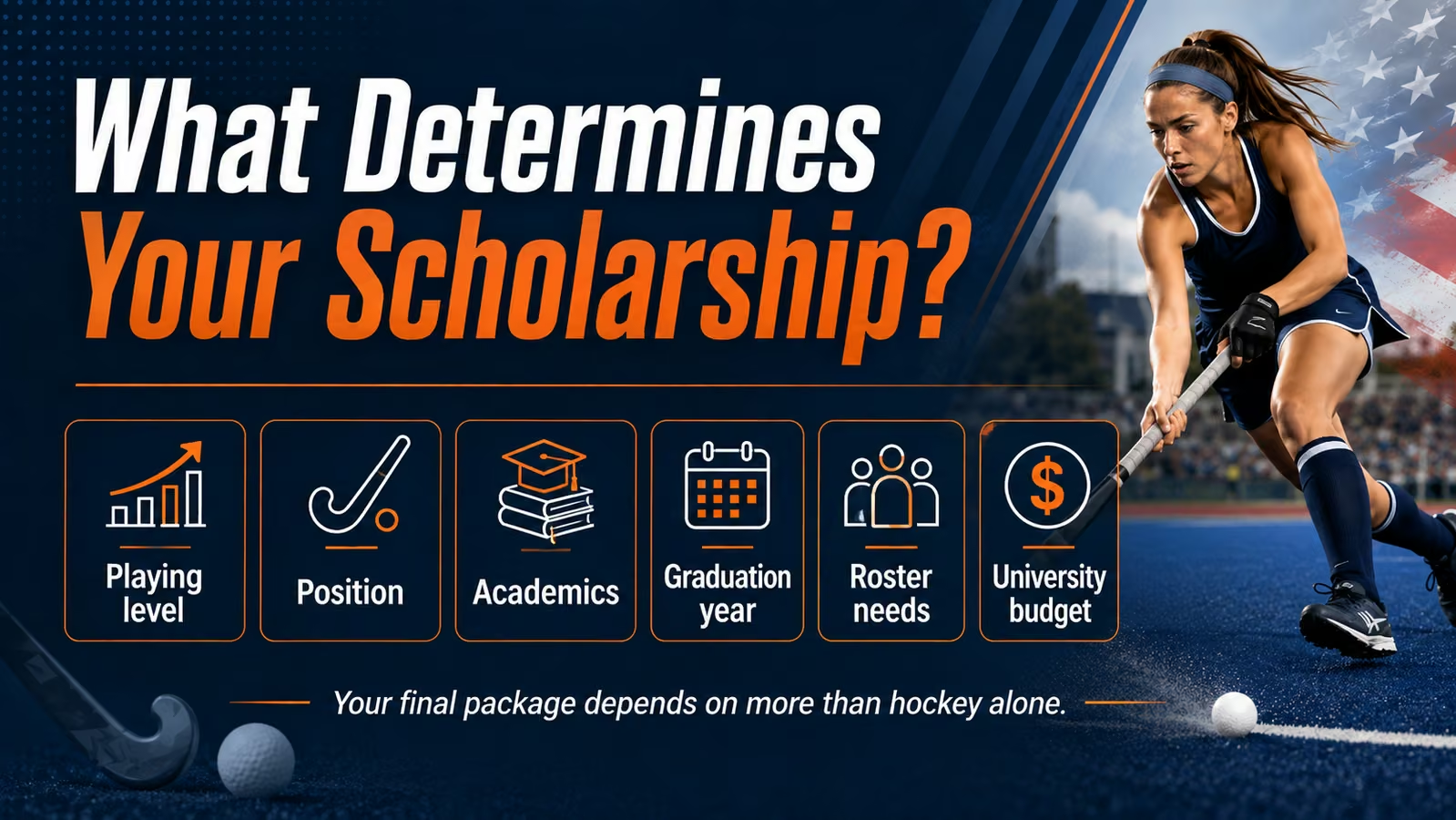
There is no standard scholarship amount for a field hockey recruit. Coaches evaluate every situation differently.
The stronger your impact can be at that program's level, the more valuable you may be as a recruit. A player capable of immediately contributing at a highly competitive Division I program is in a different recruiting position from a player who needs several years of development.
Recruiting is about more than simply finding the best players. A coach may desperately need a goalkeeper, central defender or attacking midfielder in one recruiting class while already having several players committed in another position.
College coaches recruit several years ahead. They know which players are graduating, which positions need replacing and how many roster spots they expect to have available. Being the right type of player at the right moment matters.
Scholarship budgets are planned across several recruiting classes. A coach may have significant scholarship money available for one class and very little available for another.
Strong grades can be extremely valuable. At many universities, a student-athlete may qualify for academic scholarships in addition to athletic aid. That can make you more affordable to recruit and significantly reduce the amount your family ultimately pays.
Not every program is funded equally. Two coaches competing at the same NCAA level can have very different scholarship budgets. This is particularly important under the new Division I model: the rules may allow universities to offer additional scholarships, but that does not mean every athletics department has the budget to fully fund them.
One of the biggest mistakes families make is looking only at athletic scholarship money. Your total package can consist of several forms of financial aid.
Athletic scholarship: awarded because of your value to the field hockey program.
Academic scholarship: awarded because of your grades, academic profile or sometimes standardized test results.
Need-based financial aid: based on your family's financial situation and the university's policies.
Depending on the university, some of these forms of aid can be combined. That means improving your academic profile can have a direct effect on how affordable your college options become - even if your field hockey level does not change.
Read our full guide to academic scholarships for international student-athletes.
Yes. International field hockey players can receive athletic scholarships at NCAA programs that offer them.
American college coaches actively recruit internationally, particularly in countries with strong field hockey systems such as the Netherlands, Belgium, Germany, England, Australia, New Zealand, Argentina and South Africa.
However, being talented enough athletically is only one part of the process. You also need to find universities that fit your field hockey level, academic background, preferred degree, financial situation, position, graduation year and personal preferences.
For international players, academic admissions and NCAA eligibility also need to be considered alongside the recruiting process. That is why there is rarely one universal answer to the question: "How much scholarship can I get?"
Targeting only universities that are far above your current level can leave you with very few options. At the same time, underselling yourself can mean missing opportunities. A realistic evaluation is therefore the first step.
Coaches need to quickly understand who you are. Your profile should clearly show your position, club and team, playing level, representative experience, graduation year, academic results, height, video footage and contact information.
For an international recruit, video is particularly important. A coach often cannot see you play in person during the early stages of recruitment. Your footage therefore needs to make your playing level easy to evaluate.
More emails do not automatically create more opportunities. The goal is to identify programs where your athletic level, position, academics and graduation year match what the coach needs.
Your academic profile affects much more than admission. It can open up additional universities and help create stronger financial packages.
Do not choose a university based only on the athletic scholarship percentage. Compare the final yearly cost, scholarship renewal conditions, academic fit, hockey level, playing opportunities, coaching staff, location and campus experience.
The best offer is not always the offer with the largest athletic scholarship.
Over the years, Plus31 Sports has helped more than 200 international field hockey players continue their academic and athletic careers at American universities.
Our athletes have joined programs including Rutgers, Syracuse, Wake Forest, Iowa, Michigan, Yale, UMass, Old Dominion, Hofstra, Ball State and many others.
Their routes have been very different. Some joined major Division I programs, while others found their best combination of academics, hockey and affordability elsewhere.
There is no single "best" college. The goal is to find the best college for you.
See where other players have continued their careers in our student-athlete success stories.
NCAA Division I and Division II programs can provide athletic scholarships. NCAA Division III programs cannot provide financial aid based on athletic ability, although academic, merit and need-based financial aid may be available.
The former Division I field hockey limit of 12 scholarship equivalencies is no longer the current model for participating programs. Under the new model, field hockey operates with a 27-player roster limit and universities have greater flexibility to provide athletic scholarships. This does not mean every program funds 27 full scholarships.
Division II field hockey has a maximum of 6.3 scholarship equivalencies per fully funded program. Coaches can divide this aid among multiple players.
Yes. International recruits can receive athletic scholarships if they meet the university's admissions requirements, NCAA requirements and the coach wants to recruit them.
At many universities this is possible, although scholarship and financial aid rules vary by institution. Strong academics can therefore significantly improve the total financial package.
Ivy League universities do not provide athletic or merit scholarships. Financial aid is based on demonstrated financial need.
Your scholarship opportunities depend on much more than your hockey level. Your position, graduation year, academics, video, roster needs and the universities you target all play a role.
At Plus31 Sports, we work with international field hockey players individually and assess both their athletic and academic opportunities before starting the recruiting process.
Not sure what level or scholarship options may be realistic for you?
Complete our free 2-minute First Check. We will personally review your profile and let you know what we think your next step should be.
.svg)