“I’ve Already Made My Dream Come True: I’m Going to Play Soccer in America”
Read more


A practical guide to the subjects, school records and division-specific checks that international NCAA applicants need.

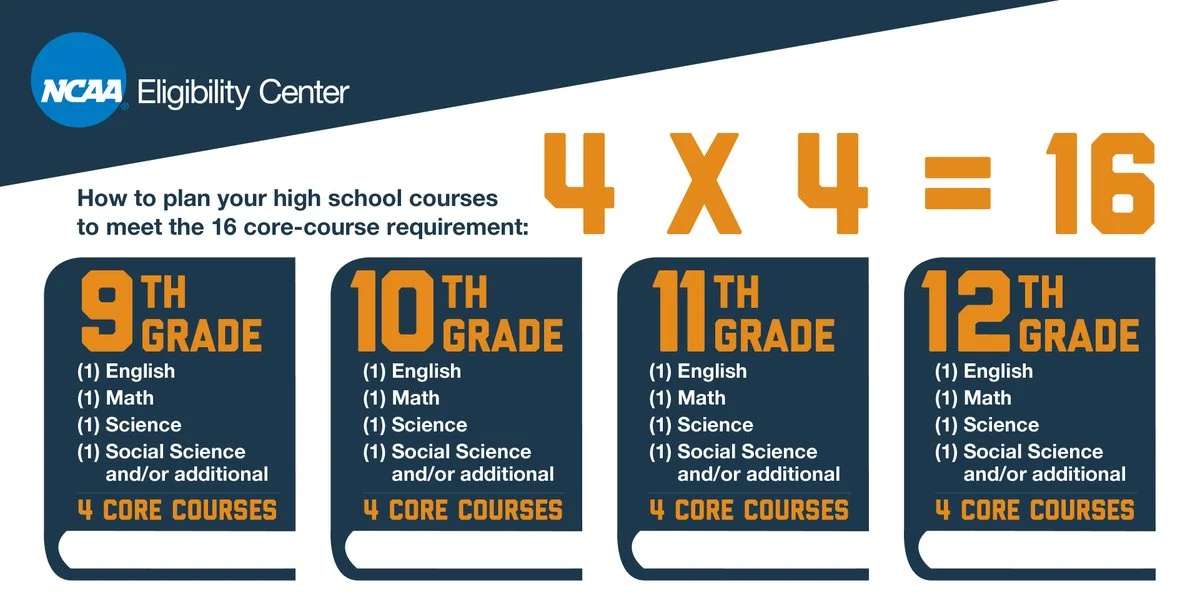
NCAA core-course requirements concern your academic preparation for Division I or II. Both divisions require 16 approved core-course credits, but their subject distributions differ. Division III schools set their own academic admission standards.
Do not count subject names on a report card and assume that the total proves eligibility. The NCAA reviews credits, grades and academic records under the rules that apply to your education system.
Core courses are academic subjects used in the NCAA eligibility review. For a U.S. high school, check its NCAA-approved course list. International records are assessed using the relevant country or education-system guidance. Some NCAA-recognized schools outside the United States follow the domestic review process.
Ask your school counselor and the recruiting university’s compliance office about uncertain courses. A school subject or diploma does not automatically establish NCAA eligibility or university admission.
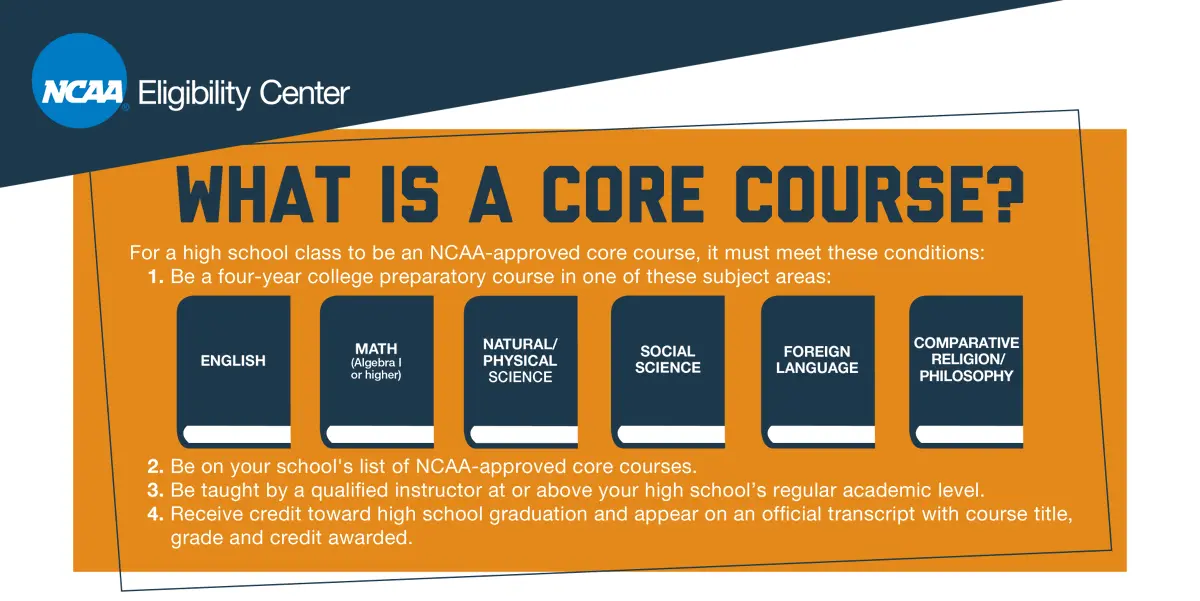
Division I: four credits in English or native language; three in math; two in science; one additional credit in English/native language, math or science; two in social science; and four additional approved core credits.
Division II: three credits in English or native language; two in math; two in science; three additional credits in English/native language, math or science; two in social science; and four additional approved core credits.
The minimum core-course GPA is 2.3 for Division I and 2.2 for Division II. This is calculated from approved core courses and may differ from your school’s overall average. These are initial-eligibility requirements, not a guarantee of admission, a roster place or financial aid.
For a broader comparison, read our guide to NCAA Division I, II and III.
The standard Division I progression rule requires ten core courses, including seven in English, math or science, before the seventh semester. Students with solely international academic credentials are exempt. Students who complete some or all of secondary school in the United States must check the applicable progression requirement.
Graduation timing and courses taken after secondary school can also affect the review. Confirm your individual record before choosing extra courses or delaying enrollment.
For international Division I and II applicants, the NCAA requests final official academic records from year nine onward in the original language, a certified line-by-line English translation where needed, and proof of graduation. Your school must submit the required official records. Follow the current country guidance and the tasks in your Eligibility Center account.
Use the education system you actually followed. For example, studying in one country does not necessarily mean its national curriculum rules apply if you completed a different international curriculum.
Division III universities set their own academic standards. International Division III athletes still need NCAA athletics certification. The Eligibility Center may request school records to establish graduation timing, so “DIII sets its own academics” does not mean “no NCAA paperwork.”
Do all NCAA applicants need the same 16-course plan?
No. Division I and II have different distributions; Division III schools set their own academic standards.
Is my school average my NCAA GPA?
Not necessarily. The NCAA calculation uses the approved coursework and rules for your record.
Can Plus31 confirm that I am eligible?
We can help you prepare and understand the process. Official certification is made by the NCAA Eligibility Center; university admission remains a separate decision.
Where should I start?
Gather your school reports and current course list. If you are exploring college sports, tell us about your academic and sporting background through the form on our website